
Security Light Not Working or Staying On?
A PIR security light fault can be a setting issue, a failed sensor, a faulty LED driver, water in the fitting, damaged cable, override wiring trouble or an RCD fault. We diagnose mains-wired security lights safely before deciding whether repair or replacement is sensible.
If the light is buzzing, flickering, wet, visibly damaged or tripping the RCD, start with safe triage before opening any exterior fitting.
Zapline gives homeowners instant triage during electrical and home emergencies — helping you understand what’s happening, reduce immediate risk and take the right next step.
No sign-up. No obligation. Just clear guidance.
Most homeowners start here before calling an electrician.
Step 2 — if you need an electrician after your diagnosis, call or WhatsApp Entigen directly.
PIR Fault, Wiring Fault or Failed Floodlight?
Security lights are simple when they work, but the fault can sit in several places. A PIR sensor may be aimed badly, an incorrect sensitivity setting may be causing false triggers, a timer or daylight setting may be wrong, the LED driver may have failed, water may have entered the fitting, or the mains wiring may be damaged or loose.
This page focuses specifically on PIR security lights and floodlights. For wider exterior lighting faults such as garden systems, driveway lights, wall lights and general outdoor fittings, see our outdoor lighting repairs guide.
A useful first distinction is behaviour: is the light staying on permanently, not triggering at all, only working sometimes, or tripping the RCD? Each symptom points to a different diagnostic route.
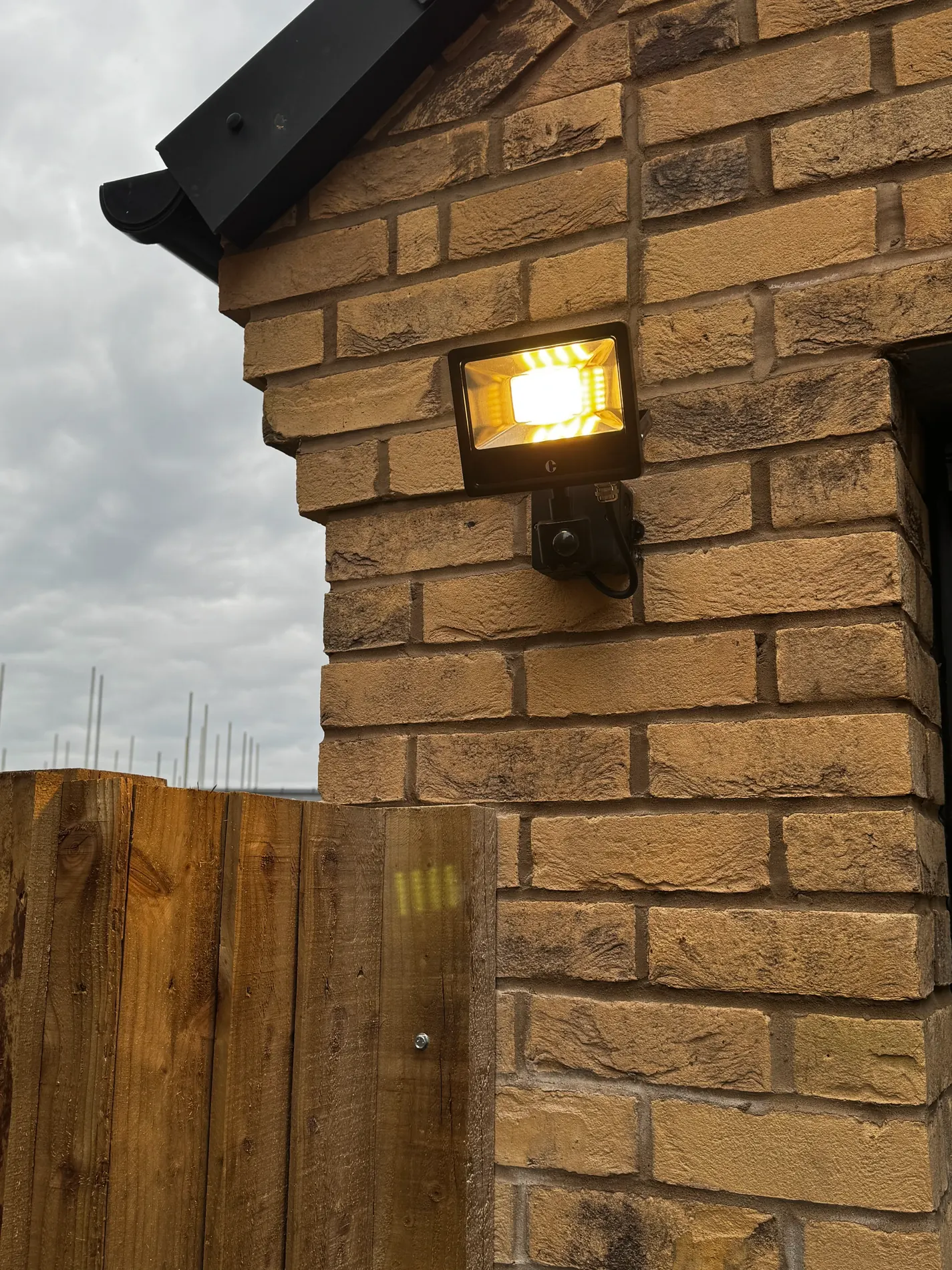
Why Security Lights Stop Working
Security Light Staying On Permanently
A security light that stays on all night is not always a wiring fault. First consider settings and triggers. The timer may be set too long, the lux setting may allow daytime operation, sensitivity may be too high, or the PIR may be aimed at a road, tree, pet route, boiler flue, heat pump outlet or reflective surface.
If the settings are sensible and the light still stays on, the PIR relay may have failed, water may be inside the sensor head, or override wiring may be forcing the fitting on. Mains-wired lights should be isolated and checked safely before parts are changed.
Security Light Not Triggering
If the light will not trigger, the daylight setting may be stopping it from operating, the PIR lens may be dirty or blocked, the sensor may be aimed above the area you walk through, or the lamp/LED driver may have failed. A PIR usually detects movement across its field better than movement directly towards it.
Intermittent operation often points to moisture, loose connections, a failing driver or a sensor that behaves differently in cold, wet or windy weather.
Mains-Wired vs Solar Security Lights
Solar security lights are simpler because they normally avoid fixed mains wiring. They can be useful for sheds, temporary positions or low-demand areas, but performance depends on battery condition, panel position, sunlight, season and fitting quality. They are often less powerful and less reliable than a properly installed mains-wired fitting.
Mains-wired security lights usually perform better for driveways, side passages, gardens and work areas, but they need suitable cable routing, RCD protection, switching, IP-rated accessories and safe installation. Mains wiring should be checked or installed by a competent electrician.
Not every security light replacement is automatically Part P notifiable. A like-for-like replacement differs from installing a new circuit or making certain fixed-wiring alterations, which may require notification depending on the work.
Outdoor Security Lights Need Suitable Weather Protection
Outdoor fittings need a suitable IP rating for their position and exposure. A sheltered porch light has a different risk profile from a floodlight exposed to driving rain, wind and spray. The correct IP rating depends on the fitting, location, manufacturer instructions and cable entry method.
The rating only works if the fitting is installed correctly. Poor cable entry, missing glands, cracked seals, trapped gaskets or the wrong mounting angle can allow water into a fitting that looked suitable on the box.
- 1Turn off the circuit if there is water ingress, burning smell, flickering, buzzing, repeated tripping or visible damage.
- 2Do not keep resetting an RCD that trips when the security light is switched on.
- 3Do not open exterior fittings unless the circuit is safely isolated, proved dead and you are competent to work on it.
- 4Check simple external causes such as dirty lenses, blocked sensors, obvious setting changes or branches moving near the PIR.
- 5Call a qualified electrician where mains wiring, water, tripping, damage or replacement of fixed fittings is involved.
When a Security Light Can Be Repaired
Repair may make sense where a replaceable PIR head, lamp, cable entry, switch or separate driver has failed and the fitting remains weatherproof. Replacement is often better where the fitting is full of water, the casing or seals have failed, the LED driver is built in, or the old unit has become unreliable.
We do not assume a security light can always be repaired. Sometimes the safest and most cost-effective fix is a correctly selected replacement with suitable IP rating, cable entry and controls.
How an Electrician Diagnoses a PIR Security Light Fault
Entigen helps homeowners with mains security light installation, PIR floodlight faults and exterior lighting repairs across Kettering, Barton Seagrave and nearby Northamptonshire areas. If you need help with a security light fault in Kettering, contact us with photos and a short description first.
A faulty PIR, timer or RCD is not something to bypass so the light works. Those parts are part of the safety and control arrangement and need proper diagnosis.
Security Light Fault FAQs
Related electrical fault help
If your issue sounds similar, these pages may help you understand the fault before getting in touch.
Security Light Fault in Kettering?
Tell us whether the light is staying on, not triggering, tripping the RCD or only working sometimes. Photos of the fitting, switch and location help us advise the next step before attending. Attendance depends on workload, urgency, access and location.
Mon–Fri 8:30–16:30 · NAPIT Registered · Serving Kettering and Northamptonshire