
Power Loss in Part of Your House?
Half the house dark, one floor without sockets, lights on but nothing else working — partial power loss can mean several different things. Finding which one matters. We diagnose it properly, with test equipment, not guesswork.
What Partial Power Loss Usually Means in a UK Home
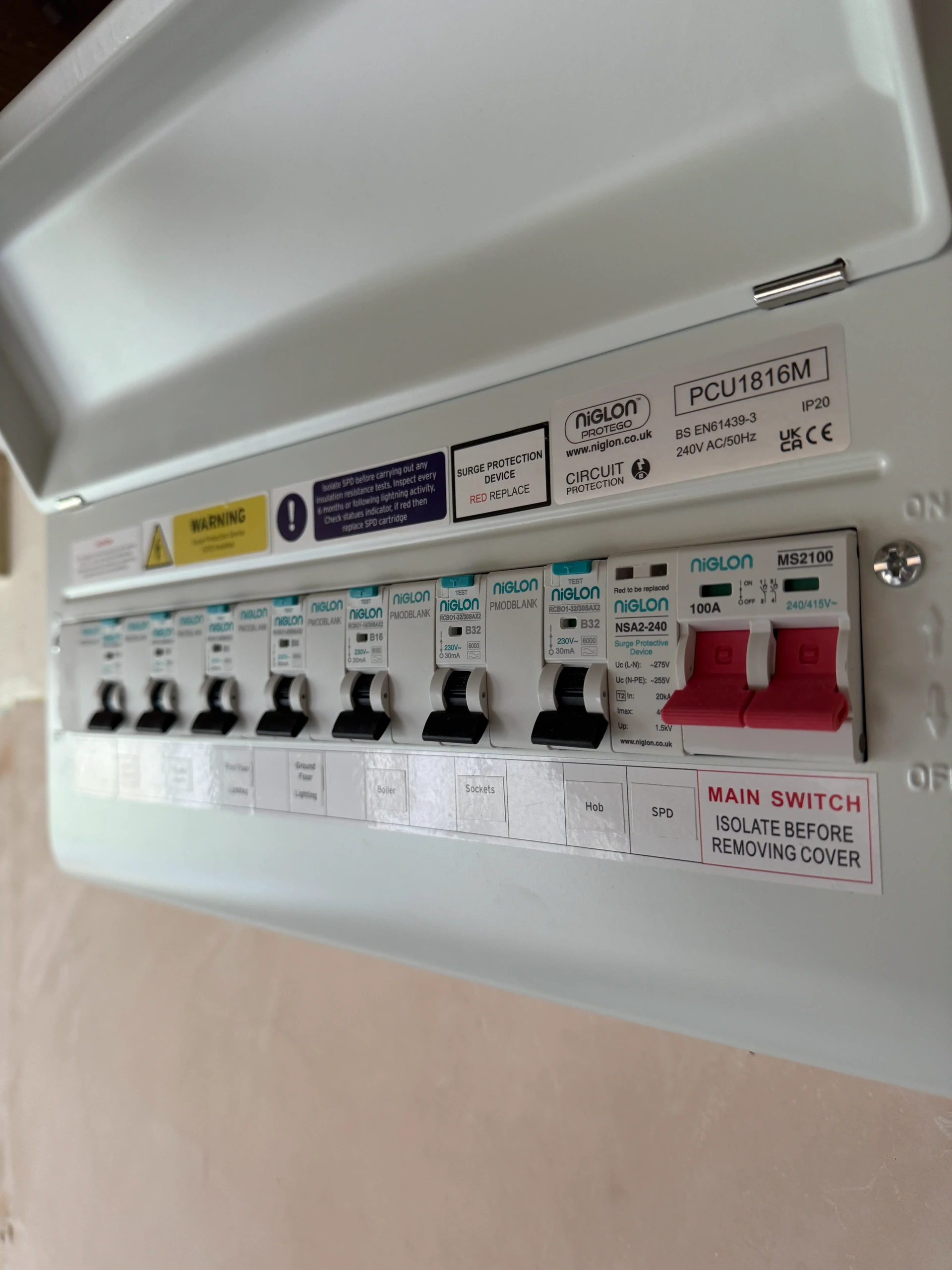
In a UK domestic property, the electrical installation is divided into individual circuits — sockets on one circuit, lighting on another, then separate dedicated circuits for the cooker, shower, EV charger and so on. Each circuit has its own protective device (MCB or RCBO) in the consumer unit. When one of those devices operates — either because the circuit has been overloaded, because a fault has caused earth leakage, or because there is a short circuit in the wiring — that circuit loses supply while everything else continues normally.
This is entirely by design. Circuit-by-circuit protection is a fundamental safety feature of modern installations. The problem is that the protective device operating is a symptom, not the diagnosis. The breaker tripping tells you something happened on that circuit — but not what, or why, or whether it's safe to restore power.
| What You're Seeing | Likely Starting Point |
|---|---|
| One circuit dead, others fine | Single MCB/RCBO trip — check the consumer unit |
| All sockets dead, lights on | Socket circuit(s) RCBO/MCB tripped |
| All lights on one floor dead, sockets fine | Lighting circuit RCBO/MCB tripped |
| Several circuits dead together (older board) | Earth fault on one of those circuits tripped the shared RCD |
| Breaker won't hold when reset | Persistent wiring fault — needs IR testing before re-energising |
| Breaker holds briefly, then trips again | Intermittent fault — appliance issue or thermal condition on wiring |
| No obvious trip, power just stopped | Neutral connection failure or loss of supply — needs urgent investigation |
| Flickering then power loss on whole house | Check if neighbours are affected — may be DNO supply issue |
Call Us Without Delay If:
- You can smell burning anywhere in the property
- The breaker trips immediately every time you reset it
- Several circuits have failed with no obvious cause
- The power loss was preceded by a loud bang or flash
- Power is flickering erratically across the whole property
Common Causes We Check For
How Entigen Diagnoses Partial Power Loss
Why You Shouldn't Keep Resetting the Breaker
A circuit breaker tripping is the installation telling you something is wrong on that circuit. Resetting it once — with all appliances unplugged — is a reasonable first step to establish whether the issue was a transient overload or a piece of faulty equipment.
But if the breaker trips again immediately with nothing connected, or trips repeatedly under normal use, continuing to reset it does not resolve the fault. It re-energises the fault each time. On a circuit with damaged cable insulation, or a connection that is arcing, this accelerates the damage — and can create a fire risk at the fault point before the protection trips again.
The same is true of the older practice of "uprating" a fuse or using a re-wireable fuse with heavier wire to stop it blowing. Increasing the protection threshold doesn't remove the fault — it just makes the protection less likely to operate before the fault causes damage or fire.
One reset with appliances unplugged → if it holds, reconnect appliances one at a time → if it trips again with nothing connected, leave it isolated and call us. Don't keep resetting.
We cover Kettering and the surrounding Northamptonshire area — Barton Seagrave, Burton Latimer, Corby, Wellingborough, Northampton, Earls Barton, Rushden, Desborough, Rothwell and surrounding areas.
Partial Power Loss FAQs
Related electrical fault help
If your issue sounds similar, these pages may help you understand the fault before getting in touch.
Lost Power in Part of Your Kettering Home?
We'll find what actually caused it — using insulation resistance testing, circuit isolation and systematic diagnosis — and fix it properly before reconnecting anything.
Mon–Fri 8:30–16:30 · NAPIT Registered · Cost Confirmed Before Attendance