
Dead Socket · Ring Final Faults · Kettering & Northamptonshire

Socket Not Working in Kettering?

One dead socket might seem minor. But it can point to a loose connection that's been getting worse, a broken ring, a failed spur, or water damage inside the wall. The cause matters — and guessing gets expensive.

<1hr
Most Faults Diagnosed
NAPIT
Registered
Ring
Circuit Testing
Free
Quote Before Work
NAPIT Registered
Ring Continuity & IR Testing
Same-Day Response
Work Certified on Completion
Workmanship Guaranteed
Understanding the Fault

What This Usually Means

A dead socket isn't always a dead socket. It might be the socket itself, but it might be the wiring upstream, the circuit protection, or a fuse you didn't know existed.

The first question we ask is: how many sockets are affected? One socket dead in isolation tells a very different story from several sockets across a room, or an entire ring circuit that's gone down. The pattern of the fault — combined with how the circuit was originally wired — points us directly to the right area before we've even tested anything.

In UK domestic properties, most socket circuits are wired as ring final circuits — a cable that leaves the consumer unit, loops around a set of sockets, and returns to the same breaker. Spurs branch off that ring to feed one or two additional outlets. If the ring is broken at any point — a failed connection in the back of a socket, a cable damaged during building work, or a loose terminal that's worked free — sockets beyond that break can go dead, sometimes intermittently.

This is why a simple plug-in socket tester can confirm a socket is dead, but can't tell you why. Proper ring continuity testing, end-to-end, is the only reliable way to find a broken ring or failed spur without opening every socket on the circuit.

What the Symptom Usually Points To
What You're Seeing Likely Cause
One socket completely deadFailed socket accessory, loose connection in that socket or adjacent socket on the ring, or failed fused spur
One side of a double socket deadWorn or failed internal contacts in that outlet — the socket needs replacing
Multiple sockets in one area deadTripped MCB/RCBO, or a break in the ring circuit upstream of those outlets
All sockets on a floor dead, lights still onSocket circuit RCBO/MCB tripped — check the consumer unit
Socket works intermittentlyLoose termination — can arc under load. Treat as urgent
Socket warm or discolouredOverheating — loose connection or overloaded circuit. Stop using immediately
Socket trips breaker when appliance plugged inFaulty appliance or, if it trips with no appliance, a fault on the circuit wiring

Stop Using the Socket Immediately If:

  • The faceplate is warm or hot to the touch
  • There is any discolouration, scorch marks or cracking on the plastic
  • You can smell burning from or near the socket
  • The socket sparks when you plug something in
  • The breaker trips every time you try to use it

These symptoms suggest arcing or overheating. Turn off the socket circuit at the consumer unit and contact us before using it again. This is not something to monitor and come back to.
Electrician checking socket wiring terminals for loose connections in Kettering
What We Look For

Common Causes We Check For

Tripped MCB or RCBOThe most common reason multiple sockets go dead at once. If the socket circuit's MCB or RCBO has tripped, everything on that circuit loses power. We check whether the trip was caused by an overloaded circuit, a faulty appliance, or a wiring fault — the answer changes whether a simple reset is safe or whether the circuit needs testing first.
Broken ring final circuitUK ring final circuits should form a complete loop. If the ring is broken at a connection point — a loose terminal, a socket that was incorrectly back-fed, or a cable that's been nicked during building work — every socket beyond that break effectively becomes a radial spur from a single point. Ring continuity testing identifies this clearly, without opening every socket.
Loose terminal connectionsConnections inside sockets, junction boxes and consumer units can work loose over time — particularly in properties that have had building work, where vibration and thermal cycling accelerate the process. A loose live or neutral terminal creates a point of high resistance that generates heat. It may work intermittently before the socket goes completely dead, or before the connection fails in a way that causes arcing.
Failed fused spurWhere sockets have been extended from the ring via a fused connection unit, there's a cartridge fuse protecting those outlets. If the fuse has blown, every socket fed from that spur goes dead. The spur's switch (if there is one) may also have failed internally. This is a common finding in kitchens where appliances have been added over the years on separate spurs.
Water ingressOutdoor sockets, sockets on external walls (particularly in older properties with solid walls and no cavity insulation), and bathroom shaver sockets can all be affected by moisture. Water tracking into the back of a socket causes corrosion of the contacts, insulation degradation on the wiring, and eventually a fault that trips the RCBO repeatedly. It can also be a source of neutral-to-earth leakage that isn't immediately obvious.
Failed socket accessorySocket outlets don't last indefinitely. Internal contacts wear through repeated insertion and removal — particularly in utility rooms and kitchens where the same outlets are used heavily. A socket can also fail from overheating if it's been used at or near its 13A rated capacity for long periods. In most cases, the socket simply needs replacing — but the wiring behind it should always be inspected at the same time.
Our Process

How Entigen Diagnoses a Socket Fault

Plugging a tester into a socket and seeing red lights tells you the socket is dead. It doesn't tell you whether the problem is the socket, the wiring, the ring, a fuse, or the consumer unit. The diagnosis has to go further than that.

01
Map the Affected Area
We establish how many sockets are affected and where they are. This immediately tells us whether we're dealing with a single-point fault, a spur failure, or a ring circuit issue. One socket dead rarely means one socket is at fault — it often means the fault is in the socket feeding it.
02
Consumer Unit Check
We check for tripped MCBs or RCBOs. If a breaker has tripped, we establish why — is it overload (appliance issue), earth fault (RCBO trip), or persistent wiring fault (trips immediately on reset)? Each scenario leads to a different next step.
03
Insulation Resistance Testing
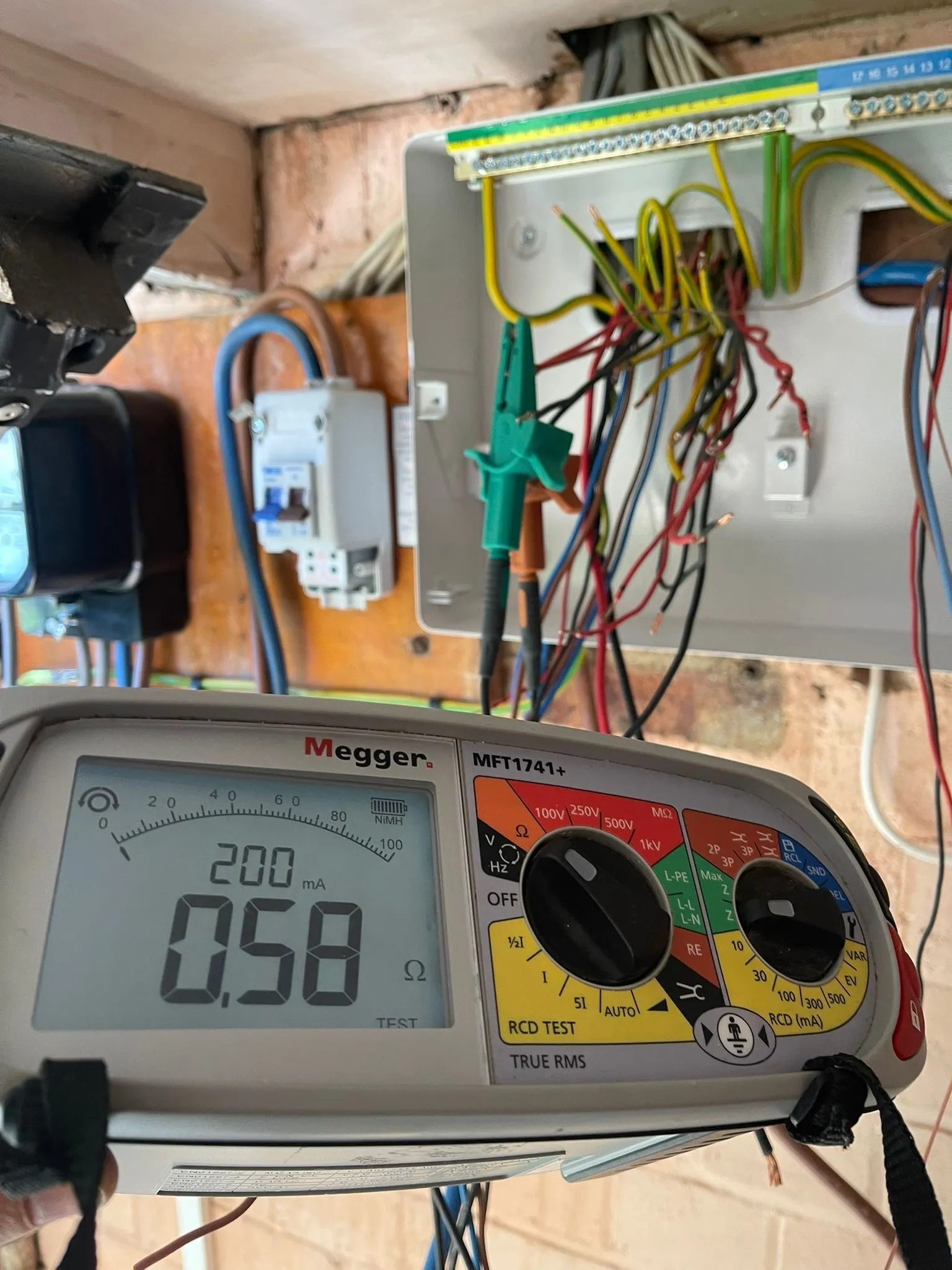
With the circuit de-energised and safely isolated, we measure insulation resistance at 500V DC across L-N, L-E and N-E. This identifies whether a cable or accessory has compromised insulation — a leakage path that might be causing an RCBO to trip without obvious cause.
04
Ring Continuity Testing
For ring final circuits, we measure continuity end-to-end on the line, neutral and CPC conductors. A broken ring shows up as a continuity imbalance — the R1, R2 and Rn values don't match what they should for a healthy ring. This identifies the break without opening every socket.
05
Accessory Inspection and Repair
Once the fault is localised, we inspect the relevant socket or connection point, identify and fix the root cause, retest the circuit, and confirm the repair is sound before re-energising. You receive a minor works certificate confirming the work is compliant.
Related Faults & Services
Coverage

We cover Kettering and the wider Northamptonshire area — Barton Seagrave, Burton Latimer, Corby, Wellingborough, Northampton, Earls Barton, Rushden, Desborough, Rothwell and surrounding areas.

Common Questions

Socket Fault FAQs

The most common causes are a tripped RCBO or MCB at the consumer unit, a blown fuse in a fused spur, a loose or failed connection within the socket or an upstream junction, a broken ring final circuit, or a failed socket accessory. The diagnostic approach changes depending on how many sockets are affected and whether they're on a ring circuit or a radial/spur arrangement. One dead socket rarely has one straightforward cause.
If only one half of a double socket is live, the internal contacts for that outlet have most likely failed — usually due to wear, overheating, or mechanical damage. A wiring fault would typically affect both outlets. The socket needs replacing, and the wiring behind it should always be inspected at the same time — particularly if there's any sign of heat damage on the terminals.
If the MCB or RCBO trips immediately when you try to reset it, there is a persistent fault on that circuit — a short circuit, damaged cable, or wiring fault that's allowing current to find an unintended path to earth. Repeatedly resetting it without finding the cause risks damaging the protection devices and masks a potentially serious fault. An electrician needs to safely isolate the circuit and carry out insulation resistance testing before re-energising.
Lighting and sockets are almost always on separate circuits in a UK consumer unit. If sockets in one area are dead but lights are live, the socket circuit's MCB or RCBO has likely tripped. Check the consumer unit — if a breaker is in the tripped position, first unplug all appliances from that area, then try resetting it. If it holds, an appliance was likely the cause. If it trips again immediately with nothing plugged in, the fault is on the circuit wiring itself.
Fault Support

If your issue sounds similar, these pages may help you understand the fault before getting in touch.

Dead Socket in Kettering or Northamptonshire?

We'll find out what's actually wrong — using proper circuit testing, not guesswork — and fix it right first time. Cost confirmed before we start.

Mon–Fri 8:30–16:30 · NAPIT Registered · Cost Confirmed Before Attendance