
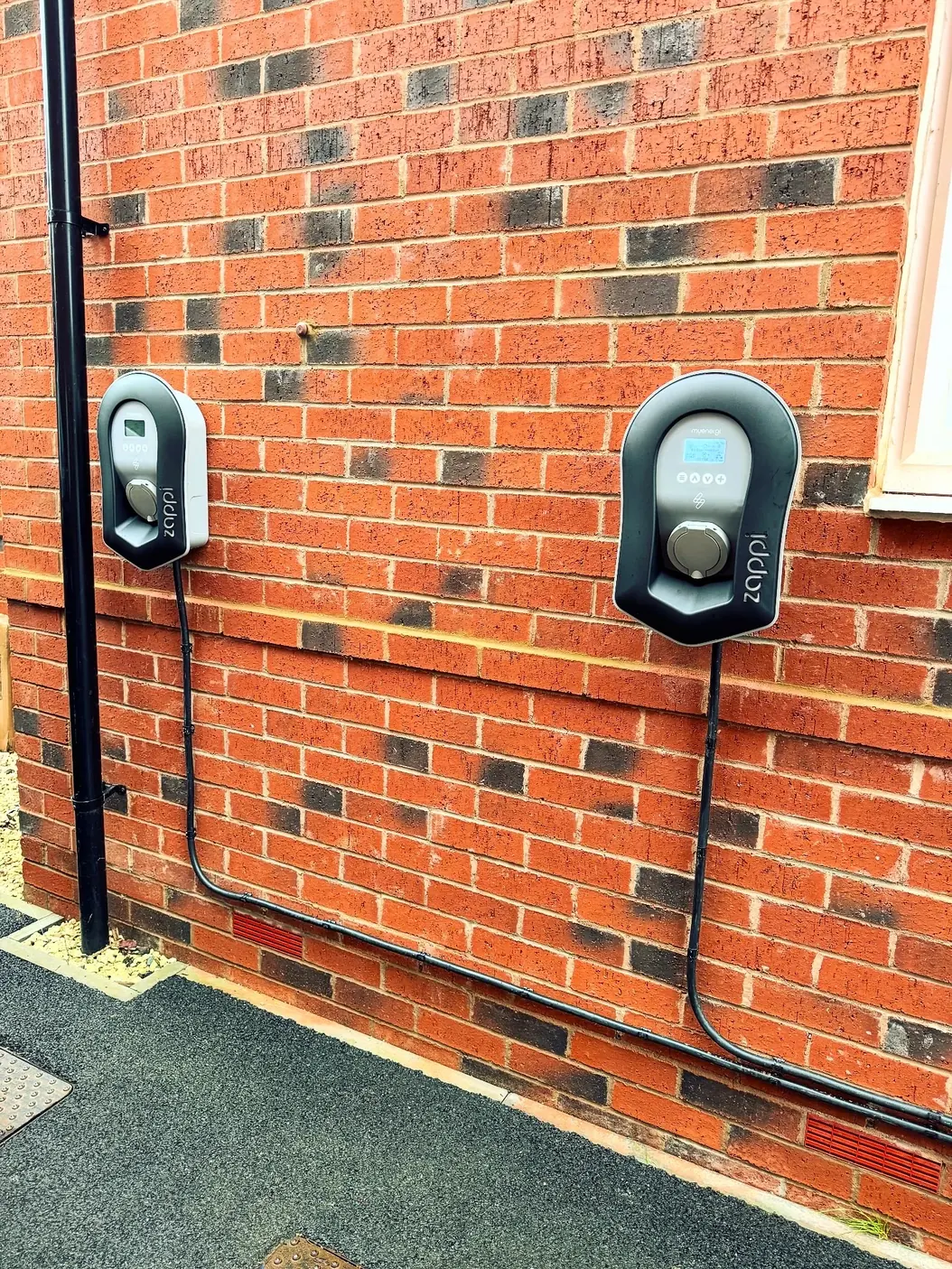
EV Charger Faults · Zappi · Hypervolt · Kettering & Northamptonshire · NAPIT-Registered

EV Charger Not Working?

Whether your Zappi, Hypervolt, or other home charger has stopped charging, keeps tripping its breaker, shows a fault indicator or just won’t communicate with your car — we diagnose EV charger faults correctly, with an understanding of both the electrical supply and the charger electronics.

NAPIT
Registered
EV
Charger Competent
BS 7671
Compliant
Same
Day Response
NAPIT Registered
EV Charger Competent
Same-Day Response
Certified on Completion
Workmanship Guaranteed
Understanding the Fault

EV Charger Faults Fall Into Four Categories

EV charger faults are different from standard electrical faults in one important respect: there are four distinct potential causes, and they require different diagnostic approaches. Getting to the right one efficiently matters — particularly if the fault leaves you unable to charge overnight.

Category 1
Supply Issue
Tripped RCBO at consumer unit, operated SPD (surge protection device), supply voltage outside acceptable limits, or loose cable terminations. The charger has no power. Check: consumer unit RCBO position, isolator switch, voltage at charger supply terminals.
Category 2
Charger-Level Fault
Internal electronics failure, firmware issue, communication module fault, or an internal RCD or DC fault sensor that has operated. Symptoms vary by brand. Check: charger app error codes, LED indicator pattern, firmware version, power cycle behaviour.
Category 3
Protection Detection Event
PEN fault protection triggered (charger detected voltage outside acceptable range), DC residual current detected (from the vehicle’s onboard charger tripping internal Type B sensing). The charger has disconnected as a safety measure. Some of these are genuine faults; some are spurious triggers from supply transients.
Category 4
Load Management / Software
A scheduled tariff is preventing charging, a load management system is capping output below the minimum needed to initiate charge, Wi-Fi/cloud connectivity has dropped and the charger has defaulted to a safe restricted mode. Not an electrical fault — but presents identically to one.
What We Check

Common EV Charger Fault Causes We Diagnose

Tripped RCBO at consumer unitThe most common first-check. EV charger circuits are protected by a dedicated RCBO — typically 32A or 40A. If the RCBO has tripped, the charger has no supply. A single reset after confirming the charger cable is disconnected from the vehicle is safe. If the RCBO trips again immediately on reset, there is a fault on the circuit that needs investigation before re-energising.
PEN fault detection activatedModern EV chargers monitor the supply voltage between line and neutral. If this drops below 207V or rises above 253V for more than a few seconds — which can indicate a failing PEN conductor in the TN-C-S supply system — the charger disconnects output as a safety measure and enters a protective fault state. A genuine PEN fault is serious: a broken combined neutral-earth conductor can put chassis voltage on connected metal parts. It needs investigation by a qualified electrician, not a simple reset.
DC residual current tripping the RCBOElectric vehicles’ onboard chargers can produce small amounts of DC residual current during charging — not unusual, and not a fault in the vehicle. However, this DC component can desensitise or trip Type A RCBOs (which are designed for AC fault currents). If the installation uses a Type A RCBO without built-in 6mA DC protection, the RCBO may trip intermittently, particularly at the start of a charge session when the vehicle is drawing high current. The fix is usually installing a Type A + 6mA DC RCBO, or verifying that the charger’s internal DC detection is active.
Loose cable terminationsEV chargers carry sustained high currents — 32A continuously for a 7kW single-phase charge session. Loose terminations at the charger input terminals or the consumer unit generate heat under load. This can cause the RCBO to trip as the cable overheats, or the charger to detect supply undervoltage due to resistive voltage drop at the loose connection. Terminations should be checked with correct torque on installation — and rechecked if the charger is moved or the consumer unit modified.
Load management capping the chargerSmart chargers (Zappi, Hypervolt, EO) use CT clamps to monitor the total house load. If the load management system calculates that adding the charger’s draw would exceed the incoming supply limit (typically the service fuse rating), it caps the charger output — sometimes to zero. This prevents the upstream service fuse from blowing. It presents as the charger not charging or charging intermittently, but it’s a designed behaviour. If the CT clamp has moved, is damaged, or is on the wrong conductor, the load management readings will be incorrect.
Connectivity and firmware issuesSmart chargers require a working internet connection for remote control, tariff-based scheduling, and solar divert functions. A dropped Wi-Fi connection can cause the charger to default to a restricted or offline mode. App updates, firmware updates, or changes to your home router can all interrupt pairing. These are not electrical supply faults — but they present identically when the charger appears unresponsive. Power cycling the charger and checking the manufacturer’s app for error codes is the starting point.
Our Process

How We Approach EV Charger Fault Diagnosis

EV charger diagnosis needs to distinguish between four fault categories before opening any enclosure. We work through the most likely cause first, based on the symptom and the charger’s error output.

01
Error Code and Symptom Triage
We check the charger’s LED pattern and app error code before touching anything else. Different charger brands use different codes — a Zappi PE Fault is different from a Hypervolt PEN detection event. The error code directs us to the right starting point.
02
Consumer Unit Check
We confirm whether the charger’s RCBO has tripped and, if so, whether it holds on reset with the charger isolated. We also check the SPD (if fitted) for indicator status — an operated SPD shows a visual indicator and will not reset until the replacement cartridge is installed.
03
Supply Voltage Measurement
With power confirmed at the consumer unit, we measure supply voltage at the charger input terminals. We check for significant voltage drop under load — which would indicate undersized cable or loose terminations. We also verify the N-E voltage is within expected range as an indicator of PEN integrity.
04
Termination and Earthing Inspection
We open the charger connection enclosure and inspect input terminations for signs of heat, loose screws, or discolouration. We verify the earth continuity to the charger body and confirm the installation earth arrangement matches what the charger expects.
05
Load Management and Software Check
If the supply is confirmed good but the charger won’t release current, we review the load management settings, CT clamp readings, and any active tariff schedules. We power-cycle the charger using the correct procedure for the specific model and test with the vehicle connected under controlled conditions.

When to Stop Using the Charger and Call Us

  • The charger shows a PEN fault warning or PE fault — stop charging immediately
  • The RCBO trips every time you try to charge
  • You notice any burning smell at the charger, cable or consumer unit
  • The charger feels hot on the outside during or after charging
  • The charger cable connection point feels loose or shows heat marks
  • Lights elsewhere in the house flicker or dim when the charger is running
EV Charger Installation

We also install new home EV chargers across Kettering and Northamptonshire — including Zappi, Hypervolt and other models. See our EV charger installation page for details.

Coverage

Barton Seagrave, Burton Latimer, Corby, Wellingborough, Northampton, Earls Barton and surrounding Northamptonshire.

Common Questions

EV Charger Fault FAQs

EV charger faults fall into four categories: supply issues (tripped RCBO, operated SPD, supply voltage problem), charger-level faults (internal electronics, firmware), protection detection events (PEN fault, DC residual current trigger), or load management/software issues (tariff schedule, load cap, connectivity). The LED or app error code is usually the first diagnostic indicator — sharing it with us helps us prepare before we attend.
A PEN fault occurs when the combined neutral and earth conductor in a TN-C-S supply system loses integrity. EV chargers monitor supply voltage — if it falls outside 207–253V for more than a few seconds, the charger assumes a PEN conductor issue and disconnects output. A genuine PEN fault is serious: a broken PEN conductor can cause chassis voltage on connected metal parts. If your charger is showing a PEN fault repeatedly, stop charging and contact us — this needs supply investigation, not repeated resets.
Repeated RCBO trips with a Zappi or other smart charger are most commonly caused by DC residual current from the vehicle’s onboard charger tripping a Type A RCBO, an oversensitive or degraded RCBO (some GARO units in Zappi installations have known failure patterns), loose cable terminations creating voltage drop, or a genuine earth fault on the circuit or within the charger. If it trips on reset with the car disconnected, the fault is in the fixed wiring. If it only trips with the car connected, the vehicle/charger interface is the starting point.
Yes. EV charger circuits require protection that includes 6mA DC fault detection — either built into the charger (many modern units include this) or via a Type B RCBO at the consumer unit. If the charger has its own built-in 6mA DC protection, a Type A 30mA RCBO at the consumer unit is typically sufficient. If it doesn’t, a Type A + 6mA DC RCBO or Type B is needed. The correct device is specified in the charger’s installation documentation — fitting the wrong type leads to either nuisance tripping or inadequate protection.
A single power cycle — turn off at the isolator or charger RCBO for 30 seconds, then restore — is safe and often clears software-related faults or recovers from a one-off supply transient. If the RCBO trips again immediately on reset, leave the circuit isolated and contact us. If the charger shows a PEN fault, do not simply reset — this is a supply integrity warning that warrants investigation.
Fault Support

If your issue sounds similar, these pages may help you understand the fault before getting in touch.

EV Charger Fault in Kettering or Northamptonshire?

We diagnose EV charger faults correctly — supply, electronics, protection events and software — and fix or advise on the right solution. Cost confirmed before attendance.

Mon–Fri 8:30–16:30 · NAPIT Registered · Cost Confirmed Before Attendance